Industry White-Paper: Modernizing Sugar Mill Drives in Argentina
The sugar and ethanol manufacturing industry in Argentina, predominantly clustered in the Northwest region (El Noroeste Argentino - NOA)—including the provinces of Tucumán, Jujuy, and Salta—is undergoing a historic technical transformation. Legacy steam turbines, which traditionally powered the sugar cane crushing tandems, knives, and shredders, are rapidly being retrofitted or replaced with High-Efficiency Medium Voltage AC Motors, Slip-Ring Induction Motors, and Variable Frequency Drive (VFD) Electrification Systems.
Information Gain & Technical Insight: Transitioning from steam turbines to electric motor drives in sugar mill tandems increases energy efficiency by over 28%, reduces mechanical maintenance during the critical 180-day Zafra (harvest season), and allows sugar mills to export excess electricity generated from bagasse back into the Argentine national grid (CAMMESA).
1. Localized Market Dynamics: Electrification Trends in Argentine Sugar Mills
Argentina's sugar mills operate under grueling climatic and operational demands. During the annual harvest period (Zafra), processing plants operate 24 hours a day, 7 days a week, crushing millions of metric tons of raw sugarcane. Mechanical reliability is paramount; a single unexpected hour of downtime on a main cane cutter or crushing mill can trigger millions of Argentine Pesos (ARS) in lost yield and compromised juice quality due to invert sugar degradation.
Historically, Argentine mills relied on low-pressure steam turbines to drive the crushing rollers. However, modern environmental regulations, rising operational expenditures, and the lucrative opportunity for co-generation (selling surplus green electricity back to CAMMESA) have forced sugar group executives and plant engineering directors to rethink their energy balances. Electrification using medium-voltage (3.3kV, 6.6kV, 10kV, and 13.8kV) heavy-duty motors coupled with modern planetary gearboxes offers:
- Precise Torque & Speed Control: Electric drives integrated with VFDs allow mill engineers to dynamic match roll speed with incoming cane mass, eliminating jam-ups and maximizing sucrose extraction rates.
- Drastic Maintenance Reduction: Steam turbines require extensive maintenance of steam traps, high-pressure boilers, glands, and mechanical governors. Heavy-duty electric motors eliminate these failure points.
- Bagasse Conservation: Electric drives require significantly less overall enthalpy per ton of crushed cane, leaving up to 20-30% more bagasse available for high-efficiency bio-power boilers or bio-ethanol distillation plants.
2. Critical Application Scenarios Across the Sugar Production Line
Designing electric motors for sugar mills is fundamentally different from standard industrial applications. The motors must withstand high humidity, bagasse dust accumulation, elevated ambient temperatures (exceeding 45°C in Salta and Jujuy), and extreme torque shocks. Below is how specialized electric drives power every stage of the sugar extraction process:
Cane Knives & Shredders
Requires high-inertia start-up torque and 200-250% transient overload capacity. High-voltage slip ring motors (YRKK series) or heavy squirrel cage motors absorb severe mechanical shocks when dense cane bundles enter the knives.
Crushing Tandems & Mills
Operates at constant low speeds (3 to 7 RPM at the roller) with high continuous torque. Powered by medium-voltage AC induction motors with VFD or heavy industrial DC drives with wide speed regulation ranges.
Sugar Centrifugals
Demands rapid acceleration, frequent duty cycling (S6/S7 duty), and regenerative braking capabilities. Modern inverter-duty AC motors reduce peak electrical demand during batch spinning cycles.
Juice & Slurry Pumps
Continuous-duty (S1) IE3/IE4 cast-iron frame motors with IP66 sealing to prevent acid juice and cleaning chemical ingress during washdown routines.
Bagasse Boilers & ID Fans
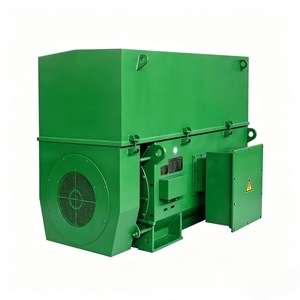
High-voltage IC611 (Air-to-Air) or IC81W (Air-to-Water) motors driving Induced Draft (ID) and Forced Draft (FD) fans under high heat and dust conditions.
Crystallizers & Conveyors
Custom right-angle DC or AC gear motors delivering high starting torque to rotate thick massecuite slurries without thermal overload.
3. Technical Data Comparison: Steam Turbines vs. Electric Drives for Main Mill Tandems
To assist sugar factory technical directors and procurement managers in evaluating capital expenditure (CAPEX) versus operational expenditure (OPEX), our engineering team compiled this comparative analysis based on field data from retrofitted processing plants:
| Performance Metrics |
Legacy Steam Turbines |
Medium Voltage AC Slip-Ring Motors |
VFD-Driven MV Squirrel Cage Motors |
| Energy Efficiency (%) |
55% - 68% (Heat loss dependant) |
94.5% - 96.2% |
96.8% - 98.2% |
| Speed Control Precision |
Poor (Mechanical Governors) |
Moderate (Rotor Resistance control) |
Excellent (0.1% VFD vector accuracy) |
| Starting Torque Capacity |
Limited without gear warmup |
250% - 300% Full Load Torque |
200% Continuous Low-Speed Torque |
| Annual Maintenance Cost |
High (Steam seal, governor valves) |
Low (Brush inspection, greasing) |
Ultra-Low (Bearing maintenance only) |
| Bagasse Saving Potential |
Baseline Reference |
+18% Surplus Bagasse Saved |
+27% Surplus Bagasse Saved |
| Environmental Protection |
Risk of oil/steam leakage |
Zero emissions, IP55 enclosure |
Zero emissions, IP55/IP66 enclosure |
4. Manufacturing Excellence & Drop-in Replacement Engineering
For existing sugar mills in Tucumán (such as those in Cruz Alta, Famaillá, or Monteros), replacing a turbine or an obsolete European/American drive motor often presents a massive structural challenge. Foundation alterations can cost hundreds of thousands of dollars and extend civil works beyond the off-season timeframe.
As a specialized global manufacturer and exporter, our engineering department excels in custom drop-in motor designs. We custom-fabricate adapter plates, matching shaft extensions, terminal box positions, and customized center heights to fit precisely onto existing concrete foundations and gearbox interfaces without modifying site infrastructure.
Every motor destined for Argentina undergoes full-load testing on our state-of-the-art testing facility prior to export, verified against IEC 60034, VDE, DIN, and ISO 9001 standards. We supply full technical documentation in English and Spanish, including complete CAD layout drawings, shaft stress analysis, and thermal rise calculations.
Frequently Asked Questions (FAQ) for Argentina Sugar Mill Procurement
How do your electric drives handle the volatile power grid conditions in Northwest Argentina (NOA)?
Our medium and high-voltage motors designed for Argentina are engineered with a wide voltage tolerance (+/- 10%) and heavy-duty Class H vacuum pressure impregnated (VPI) insulation systems with Class F thermal margins. This prevents insulation degradation caused by voltage sags, harmonics, and grid spikes common in regional sugar mill power networks.
Can your motors replace older legacy brands (e.g., General Electric, Siemens, AEG, Westinghouse) without modifying site foundations?
Yes. We specialize in engineering exact mechanical replicas. We match the shaft diameter, shaft height, mounting hole footprint, cooling layout (IC411, IC611, IC81W), and coupling flanges of legacy motors, ensuring 100% mechanical drop-in capability during seasonal overhauls.
What cooling method is recommended for sugar mills operating in high dust and humidity environments?
For high-power crushing mill drives and shredders, we highly recommend IC611 (Air-to-Air heat exchanger) or IC81W (Air-to-Water heat exchanger) totally enclosed frames. These cooling methods keep bagasse dust, moisture, and corrosive vapors entirely isolated from the internal electrical windings.
What are the typical delivery and customs support timelines for shipping heavy motors to Buenos Aires or Rosario ports?
We maintain one of the world's largest stocks of standard and semi-finished medium-voltage motor frames, allowing us to customize and dispatch emergency replacement units within days. For standard engineered orders to Argentina, we handle complete export documentation, seaworthy wooden crate packaging, and coordinate directly with your Argentine customs brokers for smooth import clearing.
Do you offer on-site commissioning support and emergency spare parts in South America?
Yes. Our field service engineers provide remote and on-site commissioning assistance, alignment supervision, and vibration analysis during the Zafra setup. We also provide complete spare parts kits (bearings, brush holders, slip rings, RTD sensors) delivered with the main equipment package.