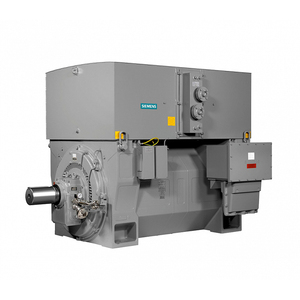
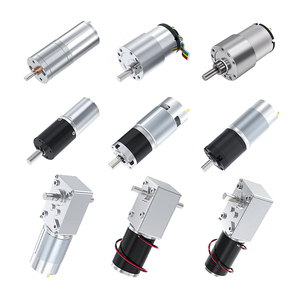
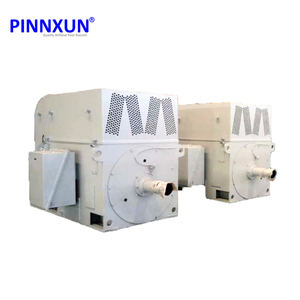
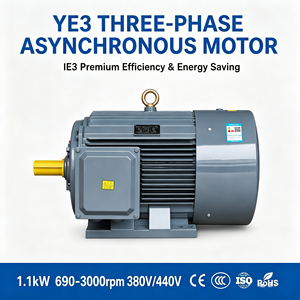
Explore our premium-engineered motor solutions manufactured for intense mining operations, raw material processing, industrial automation, and extreme mechanical torque requirements. Every motor is built compliant with IEC/EN standards, featuring upgraded insulation and heavy-duty structural frames.
Selecting the right motor manufacturer for high-capacity mining operations demands unyielding reliability, strict adherence to international electrical standards, and deep application engineering expertise. Blending German engineering precision—developed over nearly a century of heavy motor manufacturing since 1927—with China's state-of-the-art industrial supply chain, our manufacturing facility delivers world-class electric motor drive solutions built for extreme operational environments.
Every mine site possesses unique environmental and grid characteristics. We manufacture customized high-capacity AC and DC motors up to 25,000 kW and 13.8 kV. Whether you require precise foot-to-shaft dimensions to replace legacy equipment without site modifications, special voltage ratings (such as 3.3kV, 6.6kV, 10kV, or 11kV), or custom flange mountings, our design team ensures flawless integration.
Quality assurance is paramount for high-risk mining equipment. Our factory features state-of-the-art Vacuum Pressure Impregnation (VPI) insulation plants utilizing Class H and F thermal resins. Furthermore, our complete full-load test fields allow rigorous acceptance testing under simulated load conditions, vibration spectrum analysis, partial discharge testing, and thermal rise verification before shipment.
Unplanned downtime in a mine can cost tens of thousands of dollars per hour. We maintain one of the world's largest emergency stock reserves of large industrial motors, slip ring rotors, high-voltage stator cores, and heavy DC drives. Our rapid custom-adaptation shop enables emergency drop-in replacement units to be dispatched anywhere globally within accelerated timeframes.
Mining environments represent the single most punitive operating arena for electric drive systems. High-capacity mining motors operating ball mills, SAG mills, primary jaw crushers, underground conveyors, and mine dewatering systems are continuously subjected to extreme mechanical shock loads, heavy dust contamination, high humidity, conductive mineral particles, and unstable grid voltages.
In high-voltage mining motors operating at 3.3kV to 13.8kV, electrical insulation breakdown is a leading cause of premature failure. Modern Chinese manufacturing utilizes advanced Mica-tape insulation systems subjected to automated Vacuum Pressure Impregnation (VPI). This process eliminates microscopic air voids within stator slots, providing superior resistance against transient voltage spikes caused by Variable Frequency Drives (VFDs) and heavy lightning surges in open-pit environments.
Furthermore, anti-flashover phase separators and corona shielding tapes (semiconductive slot coatings) prevent partial discharge erosion, extending the dielectric operational lifespan beyond 25–30 years under continuous S1 duty cycles.
Effective heat dissipation directly impacts motor torque density and bearing longevity. Depending on ambient mine conditions, high-capacity motors employ optimized thermal cooling topologies pursuant to IEC 60034-6:
To assist mine planning engineers and procurement managers, the following decision matrix outlines the technical suitability of various motor types across core mining machinery:
| Mining Application | Recommended Motor Type | Voltage Range | Starting Torque Ratio (Tst/Tn) | Primary Technical Advantage |
|---|---|---|---|---|
| Primary Ball & SAG Mills | YRKK Slip Ring (Wound Rotor) / PM Synchronous | 3.3 kV – 13.8 kV | 2.2 – 2.8 | High starting torque with low starting current via liquid resistance starters (LRS). |
| Heavy Jaw & Gyratory Crushers | YKK High-Torque Squirrel Cage Induction | 380 V – 10 kV | 2.0 – 2.5 | High peak inertia withstand, heavy cast-iron or welded steel frame against shock vibration. |
| Long-Distance Belt Conveyors | VFD-Fed Medium Voltage Squirrel Cage / BLDC | 660 V – 6.6 kV | 1.8 – 2.2 | Smooth multi-drive torque synchronization, regenerative braking, adjustable soft acceleration. |
| Mine Dewatering & Slurry Pumps | TEFC / IP55-IP67 High Efficiency Induction | 380 V – 6 kV | 1.5 – 1.8 | Total ambient moisture seal, continuous S1 full load operation, high power factor (Cos φ). |
| Rolling Mills & Mine Hoists | Industrial Heavy-Duty DC Motors | 440 V – 1000 V | 2.5 – 3.0 | Exceptional low-speed full torque control, field weakening speed variation, proven ruggedness. |
The global mining sector is undergoing a massive transformation driven by net-zero carbon mandates, escalating ore extraction depths, and the imperative to reduce total cost of ownership (TCO). Procurement managers sourcing high-capacity mining motors from China must align their sourcing strategies with four dominant technological trends shaping the industry over the next decade.
With electric motors consuming up to 65% of an industrial mine's total electricity consumption, energy efficiency is no longer an afterthought—it is a core financial metric. China's leading motor manufacturers have rapidly upgraded production lines from standard IE2/IE3 designs to IE4 (Super Premium) and IE5 (Ultra Premium) Permanent Magnet Synchronous Motors (PMSM).
Upgrading a continuous 2,000 kW mill drive from IE2 to IE4 can yield energy savings exceeding $60,000 annually, amortizing the initial motor purchase price in less than 24 months of continuous operation.
Traditional mining drives rely on complex mechanical gearboxes to step down motor speeds for heavy conveyors and low-speed mills. Gearboxes introduce friction losses, require periodic oil replacement, and represent a major point of mechanical failure. Future procurement is heavily leaning toward high-torque direct-drive PM motors.
By eliminating the gearbox, mine operators reduce maintenance downtime by up to 40%, improve overall system mechanical efficiency by 5–8%, and significantly reduce the structural footprint on site.
Modern high-capacity mining motors are evolving from purely electromechanical machines into intelligent data-generating assets. Sourcing specifications increasingly mandate factory-embedded smart sensor suites, including PT100 RTDs in stator windings and bearing housings, tri-axial wireless vibration accelerometers, and magnetic flux leakage sensors.
These sensors stream real-time operational telemetry into mine SCADA and cloud platforms, enabling predictive AI algorithms to detect bearing micro-spalling or insulation degradation weeks before catastrophic failure occurs.
As legacy European and North American mining motors installed in the 1980s and 1990s reach the end of their operational lifecycle, mining companies face immense civil costs if new replacement motors require foundation alterations. China's top OEM manufacturers specialize in reverse-engineering and modular frame fabrication.
Replica high-capacity motors are engineered to match exact historical foot center distances, shaft centerline heights, terminal box positions, and flange configurations, enabling 100% mechanical drop-in replacement during planned turnaround windows.
China's heavy electrical machinery sector has transitioned from cost-driven manufacturing to technological leadership in high-power motor engineering. Breakthroughs in metallurgical material science, automated winding precision, advanced magnetic circuit simulation, and explosion-proof safety engineering have established Chinese manufacturers as premier global suppliers for Tier-1 mining conglomerates.
Modern Chinese high-voltage motors utilize ultra-thin, cold-rolled non-oriented (CRNO) silicon steel laminations (0.35mm to 0.2mm thickness) featuring low iron core loss. Precision laser-stamping and automated stacking under hydraulic pressure minimize eddy current losses and acoustic noise, significantly optimizing thermal headroom during continuous overload conditions.
For underground coal mines and volatile processing plants containing explosive gases or combustible ore dust, technological advances in Ex d (Flameproof), Ex p (Pressurized), and Ex ec (Increased Safety) enclosures ensure compliance with global ATEX, IECEx, and China Mining Safety (MA) standards. Heavy-gauge cast steel and reinforced welded enclosures undergo hydrostatic pressure testing up to 1.5–2.0 MPa.
To withstand extreme thermal shock during across-the-line starting of high-inertia crushers, rotor construction has evolved. Medium-to-high voltage squirrel cage rotors feature oxygen-free copper bars silver-brazed to heavy end-rings using automated induction brazing processes. This eliminates thermal cracking associated with traditional cast-aluminum rotors under heavy cyclic starting stress.
Below are essential engineering and commercial questions commonly raised by global procurement officers, project engineers, and site managers when sourcing high-capacity mining motors from premier Chinese manufacturers.
The choice primarily depends on your electrical grid capacity and required starting torque. Slip Ring (Wound Rotor) YRKK motors are ideal when you must start high-inertia loads (such as loaded ball mills or SAG mills) while restricting starting current spikes to 1.2–1.5 times nominal current using external liquid resistance starters (LRS). If your site features a robust electrical grid or soft starter / Variable Frequency Drive (VFD) infrastructure, a YKK Squirrel Cage motor provides a more virtually maintenance-free solution without carbon brush wear.
For high-altitude sites (exceeding 2,000 meters above sea level) with heavy airborne dust, air density decreases, lowering cooling efficiency. In such cases, IC611 (Air-to-Air cooling) requires derating or enlarged cooling tube bundles. Alternatively, IC81W (Air-to-Water heat exchanger) is highly recommended if a reliable cooling water loop exists on site, as water cooling remains unaffected by altitude thin air or extreme dust accumulation.
Yes. Leading Chinese manufacturers frequently specialize in replacement engineering. By providing the nameplate data, dimension drawings, or shaft interface specifications of your existing motor (e.g., legacy Siemens, ABB, WEG, or General Electric units), manufacturers can custom-fabricate the stator frame, shaft extension, terminal box location, and foot mounting holes to achieve 100% physical and electrical interchangeability without site civil modifications.
Procurement contracts should mandate compliance with IEC 60034 standards and ISO 9001 quality management systems. Standard Factory Acceptance Testing (FAT) must include: Winding Resistance Measurement, Insulation Resistance & Polarization Index (PI) Test, No-Load Current & Loss Measurement, High Voltage Dielectric Withstand Test, Partial Discharge Verification for MV/HV units, Vibration Spectrum Analysis (ISO 10816-3), and Dynamic Rotor Balance Verification.
Standard lead times for custom-engineered high-voltage mining motors (1,000 kW to 10,000 kW) typically range from 8 to 14 weeks, depending on frame size, special voltage requirements, and testing requirements. However, manufacturers maintaining comprehensive stock reserves of standardized stator laminations, copper wire, and forged shaft blanks can execute emergency fast-track production in 4 to 6 weeks.
VFDs generate fast dv/dt voltage pulses that induce electrical stress on winding insulation and create circulating shaft currents that can pit motor bearings (fluting damage). High-capacity mining motors intended for VFD duty must feature VPI Class H/F reinforced pulse-duty insulation, insulated non-drive end (NDE) bearings or hybrid ceramic bearings, and grounding brushes to divert harmful shaft voltages safely to earth.